Crude Oil Futures (CL)
The Most Volatile Major Commodity — Energy Futures Trading with Regime-Aware Risk Management
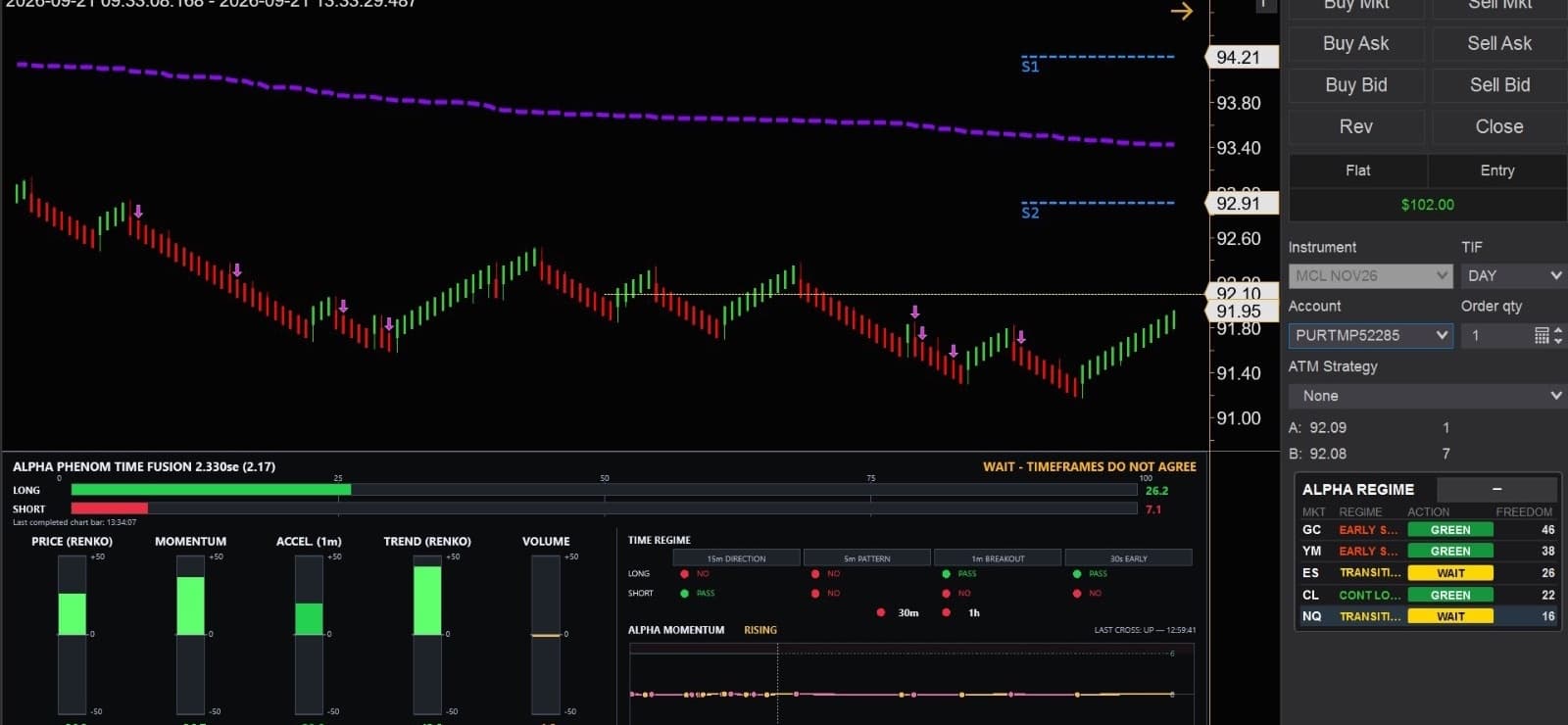
Crude Oil Futures (CL) on NYMEX are the global benchmark for energy pricing. With $10 per tick and average daily ranges of 200-400+ ticks, CL offers explosive profit potential — and equally explosive risk. Crude oil is uniquely sensitive to geopolitical events, OPEC decisions, EIA inventory reports, and broader risk sentiment. AQS Alpha Regime's inclusion of CL in its 5-market classification provides essential context: when oil spikes due to supply disruption while equities are stable, it's a sector-specific event — not a regime change.
Complete Guide
Crude Oil Futures (CL)
Contract Specifications
Why Trade CL?
Extreme volatility — 200-400+ tick daily ranges create multiple high-profit opportunities per session.
Unique fundamental catalysts (EIA inventories, OPEC, geopolitics) create sharp directional moves ideal for Alpha Signal triggers.
Micro Crude (MCL) at $100/point provides accessible risk management for prop firm accounts.
CL's regime behavior provides critical context for AQS Alpha Regime — energy sector disruptions often precede broader market rotations.
Strong morning session correlation with NQ/ES at the cash open creates multi-market confluence opportunities.
Session Breakdown
When to trade CL — and when to stand down.
Asian / Globex Overnight
5:00 PM – 2:00 AM CTAsian demand sets the tone. Geopolitical events (Middle East, Russia) often break during these hours, creating gap risk.
European Open
2:00 AM – 7:00 AM CTNorth Sea Brent pricing influences CL. European refinery demand and ICE Brent arbitrage create directional flows.
NYMEX Open / Cash Open
8:00 AM – 10:30 AM CTHighest CL volume. The 8:30 AM CT equity open amplifies oil moves. Alpha Explosion targets the opening momentum breakout.
EIA Inventory Report
9:30 AM CT (Wednesdays)The single most impactful weekly event for CL. 50-100+ tick moves in minutes. Alpha Regime classifies this as Red — stand down before the number.
Afternoon Session
10:30 AM – 1:30 PM CTCL often enters balance after morning catalysts. Mean reversion to VWAP becomes the dominant strategy.
Key Institutional Levels
PDH / PDL
CL respects previous day levels aggressively. Breakout-and-retest patterns at PDH/PDL are CL's highest-probability setups.
VWAP
Mean reversion to VWAP after morning volatility is the most reliable afternoon CL strategy.
Round Numbers ($70, $75, $80)
Oil trades around psychological levels heavily due to options activity and OPEC targeting.
EIA Reaction Level
The high/low established in the first 5 minutes after EIA becomes a key reference for the rest of the session.
Weekly Open
CL's Sunday open often sets the directional bias for the week, especially after weekend geopolitical developments.
AQS Indicators for CL
How each indicator is calibrated for CL's unique microstructure.
Alpha Regime
CL is the canary in the coal mine for geopolitical risk. Alpha Regime monitors CL as one of its 5 markets — a CL spike during stable equities signals sector-specific risk, not a regime change. This distinction prevents false stand-down signals.
Alpha Signal
CL's extreme volatility demands wider stops and larger targets. Alpha Signal automatically adjusts its risk brackets for CL's tick characteristics — typically 20-40 tick stops with 60-120 tick targets.
Alpha Fusion
Crude oil's concentrated institutional participation creates textbook absorption patterns. Alpha Fusion detects the large producer/consumer hedging flows at key support/resistance levels.
Alpha Explosion
CL compression breakouts are the most explosive in futures. Alpha Explosion's volume confirmation prevents you from entering false breakouts caused by thin overnight liquidity.
Prop Firm Considerations for CL
CL is high-risk, high-reward on prop firms. A single CL tick ($10) can quickly erode trailing drawdown — use MCL ($1/tick) exclusively.
EIA inventory Wednesdays at 9:30 AM CT — NEVER trade CL during inventory releases on a prop firm account.
CL's physical delivery requirement means you must roll to the next contract before expiration. Set calendar reminders.
Some prop firms restrict CL during certain hours or around OPEC meetings. Check your firm's specific rules.
Alpha Regime's Red classification during EIA/OPEC events is your automatic safety net — even if you forget to check the calendar.
Frequently Asked Questions — CL
Is crude oil good for day trading?
What is the tick value of crude oil futures?
When is the EIA crude oil inventory report?
Should I trade CL on a prop firm challenge?
What makes crude oil so volatile?
Explore Other Contracts
Trade CL with Institutional Indicators
Join the Toronto-based live trading desk at 9:20 AM EST. Watch AQS indicators analyse CL in real-time before you commit. CAD $250/month — all 4 indicators included.