Dow Jones E-mini Futures (YM)
The Industrial Bellwether — Blue-Chip Futures Trading with Cross-Market Regime Intelligence
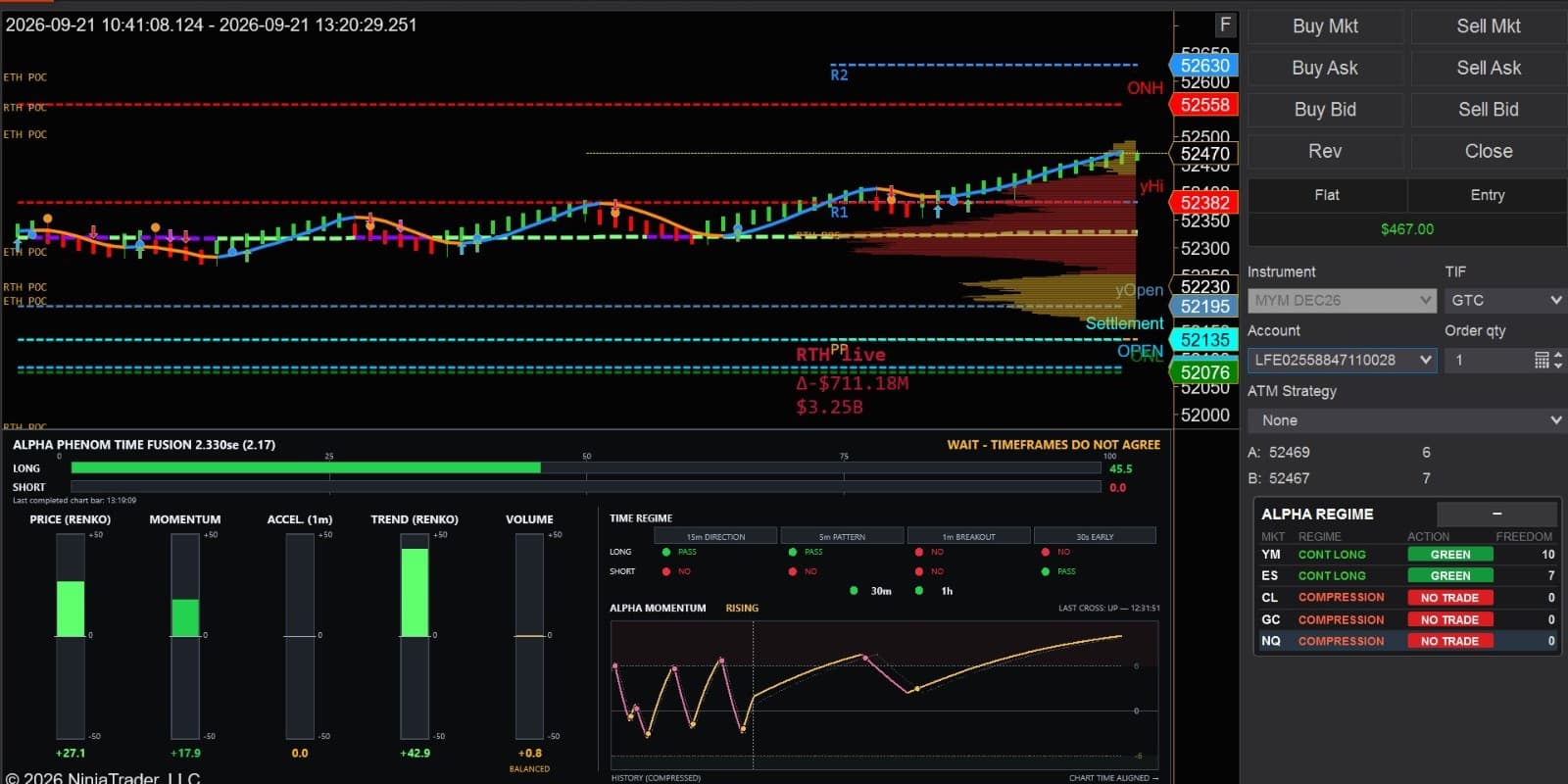
Dow Jones E-mini Futures (YM) track the Dow Jones Industrial Average — 30 of America's largest blue-chip companies including Boeing, Goldman Sachs, UnitedHealth, and Caterpillar. YM's industrial and financial sector concentration gives it a distinctly different character from tech-heavy NQ or broad-market ES. This divergence is precisely what makes YM invaluable in AQS Alpha Regime's multi-market classification: when NQ rallies on tech earnings but YM lags due to industrial weakness, the regime is rotational — not broadly bullish.
Complete Guide
Dow Jones E-mini Futures (YM)
Contract Specifications
Why Trade YM?
Blue-chip stability — YM is less volatile than NQ, making it suitable for conservative prop firm strategies.
$5/point tick value is the most accessible E-mini contract — lower barrier to entry for new futures traders.
Industrial/financial sector focus provides regime diversification when cross-referenced with NQ's tech concentration.
MYM at $0.50/tick is the smallest risk-per-tick of any major E-mini — ideal for building prop firm cushion.
YM's sector rotation signals are critical inputs for Alpha Regime's Green/Yellow/Red classification.
Session Breakdown
When to trade YM — and when to stand down.
Globex Overnight
5:00 PM – 8:30 AM CTQuietest of the three equity E-minis overnight. YM gaps on industrial earnings and economic data.
Pre-Market
7:30 AM – 8:30 AM CTDow component earnings (Boeing, Goldman, etc.) cause pre-market moves. ISM Manufacturing data particularly impacts YM.
Cash Open
8:30 AM – 10:30 AM CTYM establishes its daily range. Less explosive than NQ but more predictable. Alpha Signal entries are most reliable during this window.
Midday
10:30 AM – 1:30 PM CTYM enters tight balance zones more often than NQ. VWAP mean reversion is highly reliable. Low-risk, low-reward setup.
Close
2:00 PM – 3:15 PM CTInstitutional rebalancing flows. YM's price-weighted nature means single-stock moves (e.g., UNH, GS) can drive the index.
Key Institutional Levels
PDH / PDL
YM respects previous day levels. Its lower volatility makes PDH/PDL tests more orderly and easier to trade.
VWAP
YM's mean-reverting nature makes VWAP the #1 reference level. Deviation-and-return patterns are highly reliable.
Round Numbers (40000, 41000)
The Dow's prominence in financial media makes round numbers major psychological levels.
Opening Range
YM's first 30-minute range is typically 50-80 points. Extension beyond 1.5x OR signals a directional day.
NQ-YM Spread
The relative performance of NQ vs YM reveals sector rotation. Widening spread = tech outperformance; narrowing = rotation to industrials.
AQS Indicators for YM
How each indicator is calibrated for YM's unique microstructure.
Alpha Regime
YM is the industrial heartbeat in Alpha Regime's 5-market classification. When NQ leads (tech rally) but YM lags (industrial weakness), the regime is rotational — Alpha Regime classifies this as Yellow (caution), preventing false confidence in narrow rallies.
Alpha Signal
YM's lower volatility produces tighter Alpha Signal risk brackets. Smaller stops (15-30 points at $5/point = $75-$150 risk) make YM ideal for building consistent daily P&L on prop firm challenges.
Alpha Fusion
YM's price-weighted nature means institutional flows in high-priced Dow components (UNH, GS) create detectable absorption at PDH/PDL levels. Alpha Fusion reads these institutional rotations.
Alpha Explosion
YM compression breakouts are less frequent but more reliable than NQ. When Alpha Explosion fires on YM, it often signals broad market consensus rather than single-sector momentum.
Prop Firm Considerations for YM
YM is the safest E-mini for conservative prop firm strategies — $5/point means lower risk per contract.
MYM at $0.50/tick is the smallest risk available on any major E-mini — perfect for micro-managing trailing drawdown.
YM's lower volatility means slower profit accumulation but significantly fewer drawdown-triggering events.
Consider YM on high-volatility days when NQ regime is Yellow/Red — YM often remains tradeable when tech is chaotic.
YM's price-weighted nature means single-stock events can cause sudden moves — check Dow component earnings calendar.
Frequently Asked Questions — YM
Is YM good for beginners?
What is the difference between YM and NQ?
How many ticks is a point in YM?
Can I trade YM on prop firm challenges?
Why is YM important for regime detection?
Explore Other Contracts
Trade YM with Institutional Indicators
Join the Toronto-based live trading desk at 9:20 AM EST. Watch AQS indicators analyse YM in real-time before you commit. CAD $250/month — all 4 indicators included.