S&P 500 E-mini Futures (ES)
The World's Most Liquid Futures Contract — Benchmark Index Trading for Institutional-Grade Execution
The S&P 500 E-mini (ES) is the most liquid futures contract on earth — trading over 1.5 million contracts daily. It tracks the S&P 500 index, representing the 500 largest U.S. companies across all sectors. ES's unmatched depth-of-book and tight spreads make it the ideal contract for institutional-grade order flow analysis with AQS Alpha Fusion. Where NQ is directional and volatile, ES is balanced and mean-reverting — requiring a different tactical approach.
Complete Guide
S&P 500 E-mini Futures (ES)
Contract Specifications
Why Trade ES?
Deepest order book of any futures contract — sub-penny spreads during RTH ensure minimal slippage on entries and exits.
Broad market exposure reduces single-sector risk compared to NQ's tech concentration.
Mean-reverting tendencies make ES ideal for Alpha Signal's precision entries at statistical extremes.
Micro E-mini MES at $5/point provides the finest granularity for prop firm drawdown management.
Institutional MOC (market-on-close) flows create reliable late-session directional moves detectable by Alpha Fusion.
Session Breakdown
When to trade ES — and when to stand down.
Globex Overnight
5:00 PM – 8:30 AM CTThinner but still substantial volume. Overnight range establishes key reference levels. ES is less volatile overnight than NQ.
Pre-Market / Data Releases
7:30 AM – 8:30 AM CTEconomic data releases (NFP, CPI, GDP) cause sharp moves. Alpha Regime classifies these as Red — stand down until volatility settles.
Cash Open
8:30 AM – 10:30 AM CTInitial balance formation. ES typically establishes 60% of its daily range. Alpha Explosion captures the opening drive breakout.
Midday Balance
10:30 AM – 1:30 PM CTES enters balance zones more reliably than NQ. VWAP mean reversion is the highest-probability play. Alpha Signal excels here.
MOC / Close
2:00 PM – 3:15 PM CTInstitutional MOC orders drive directional moves. Alpha Fusion detects the absorption pattern as institutions execute closing flows.
Key Institutional Levels
PDH / PDL
Previous day extremes. ES respects these levels more consistently than NQ due to broader institutional participation.
VWAP + Developing VWAP
The single most important level for ES. Mean reversion to VWAP is the highest-probability ES trade setup.
Initial Balance (IB)
First hour range. ES tends to range within 1.5x IB extension on normal days. Breakout beyond 2x IB signals a trend day.
Value Area High/Low (VAH/VAL)
Volume profile levels from prior session. ES auctions between VAH and VAL during balance days.
Weekly VWAP
Institutional benchmark for swing traders. ES tends to test weekly VWAP on Thursdays/Fridays.
AQS Indicators for ES
How each indicator is calibrated for ES's unique microstructure.
Alpha Fusion
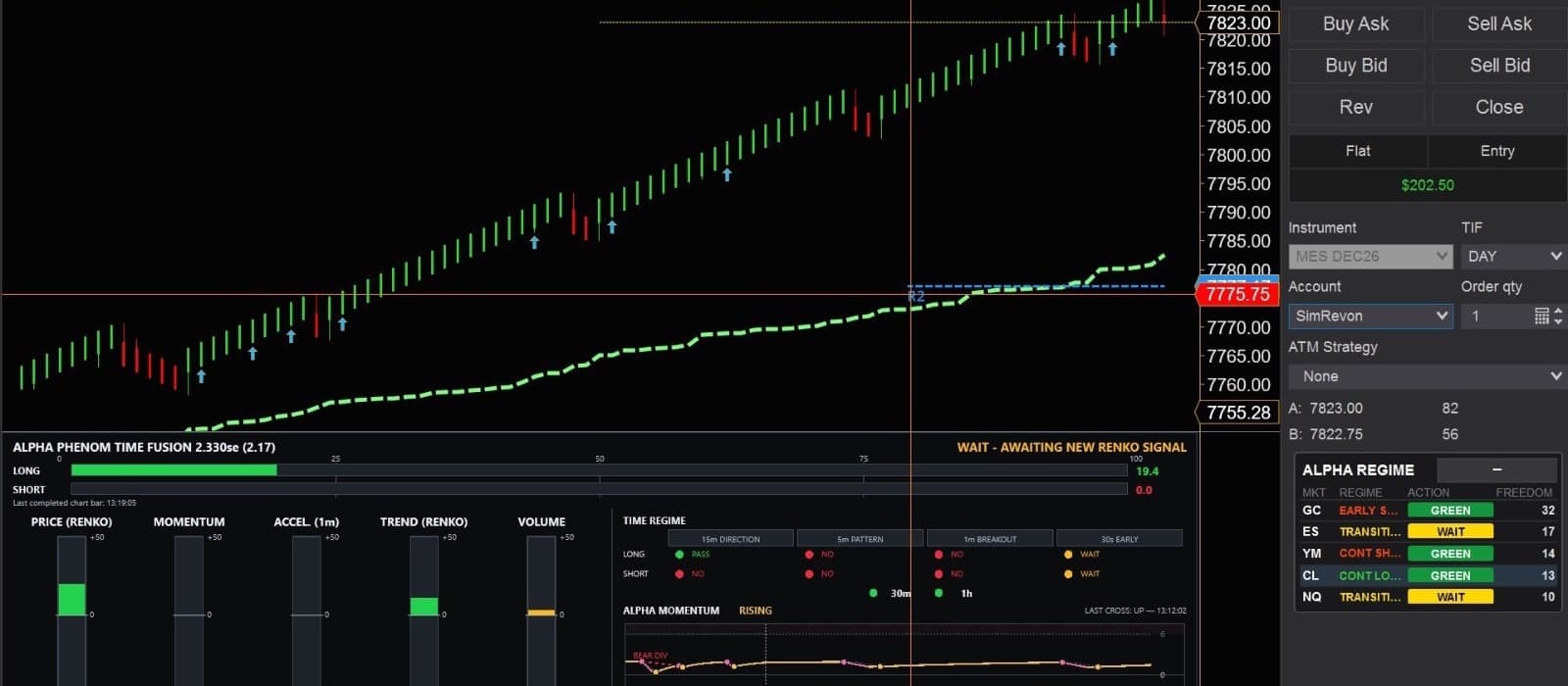
ES's unmatched depth-of-book makes order flow absorption the most reliable signal. Alpha Fusion's bid/ask delta analysis is at its most accurate on ES due to the tightest spreads in futures.
Alpha Signal
ES's mean-reverting tendencies align perfectly with Alpha Signal's statistical execution triggers. Entries at 2+ standard deviation extremes have the highest reversion probability on ES.
Alpha Regime
ES is the benchmark for regime classification. When ES is Green but NQ/YM diverge, it signals rotational activity rather than broad risk-on/risk-off — a nuanced signal only multi-market regime detection reveals.
Alpha Explosion
Less frequent on ES than NQ, but when ES compression breakouts fire, they carry higher conviction due to broader market participation. Alpha Explosion's volume confirmation filter is critical for ES.
Prop Firm Considerations for ES
ES is the safest instrument for conservative prop firm strategies due to its lower volatility and tighter spreads.
On a $50K Topstep Combine, ES's lower daily range means slower profit accumulation but significantly reduced drawdown risk.
MES at $5/point provides excellent granularity — a 2-point stop = $10 risk per contract, allowing precise position sizing.
ES's mean-reverting nature suits traders who prefer range-based strategies with Alpha Signal over momentum plays.
Consider ES during FOMC/NFP days when NQ's tech concentration amplifies volatility beyond comfortable prop firm risk levels.
Frequently Asked Questions — ES
Is ES better than NQ for prop firm challenges?
What is the tick value of ES futures?
What makes ES the most liquid futures contract?
What is the best strategy for ES futures?
Can I trade ES and NQ together?
Explore Other Contracts
Trade ES with Institutional Indicators
Join the Toronto-based live trading desk at 9:20 AM EST. Watch AQS indicators analyse ES in real-time before you commit. CAD $250/month — all 4 indicators included.