Nasdaq 100 E-mini Futures (NQ)
The Premier Technology-Heavy Futures Contract for Day Traders & Prop Firm Challenges
The Nasdaq 100 E-mini (NQ) is the flagship futures contract for technology-sector exposure, tracking the 100 largest non-financial companies on the Nasdaq exchange — including Apple, Microsoft, NVIDIA, Amazon, and Meta. With $20 per point tick value and its Micro counterpart MNQ at $2 per point, NQ offers the volatility and liquidity that professional day traders and prop firm challengers demand. AQS indicators are calibrated specifically for NQ's unique microstructure: rapid gap fills, VWAP mean reversion, and institutional order flow at previous day high/low (PDH/PDL) levels.
Complete Guide
Nasdaq 100 E-mini Futures (NQ)
Contract Specifications
Why Trade NQ?
Highest average daily range of any E-mini contract — 200-400+ point daily moves provide multiple trading opportunities.
Deep institutional liquidity at key levels (PDH, PDL, VWAP, opening range) creates reliable order flow patterns.
Technology sector sensitivity creates directional momentum that Alpha Fusion detects at sub-millisecond resolution.
Micro E-mini MNQ allows precise position sizing at 1/10th the cost — critical for prop firm drawdown management.
Cash open (9:30 AM EST) volatility compression is the single best session for Alpha Explosion breakout detection.
Session Breakdown
When to trade NQ — and when to stand down.
Globex Overnight
5:00 PM – 8:30 AM CTLower volume, range-bound. Institutional positioning creates PDH/PDL levels that become key magnets during RTH.
Pre-Market / European Open
2:00 AM – 8:30 AM CTEuropean institutional flow increases volume. Gap analysis from Asia session close provides directional bias.
Cash Open
8:30 AM – 10:30 AM CTHighest volatility window. Alpha Explosion targets the first 30-minute compression breakout. 60%+ of daily range established here.
Midday Lull
10:30 AM – 1:30 PM CTReduced volume, mean reversion. Alpha Regime often classifies this as Yellow (caution). Professional traders reduce size or stand down.
Power Hour / MOC
2:00 PM – 3:15 PM CTInstitutional market-on-close (MOC) orders drive directional moves. Second-best window for Alpha Signal triggers.
Key Institutional Levels
PDH (Previous Day High)
Primary institutional magnet. Alpha Fusion detects absorption at PDH for reversal or breakout confirmation.
PDL (Previous Day Low)
Institutional support/resistance. Bid/ask delta absorption at PDL signals smart money accumulation.
VWAP
Volume-weighted average price. Mean reversion target for NQ — most reliable during midday lull sessions.
Opening Range (OR)
First 15-30 minute range. Alpha Explosion targets the OR breakout with volume confirmation.
Globex High/Low
Overnight session extremes. RTH tests of Globex levels often trigger institutional order flow.
AQS Indicators for NQ
How each indicator is calibrated for NQ's unique microstructure.
Alpha Fusion
Detects institutional bid/ask delta absorption at NQ's PDH/PDL levels. NQ's deep book makes order flow absorption the most reliable signal for trend initiation.
Alpha Signal
Generates non-repainting execution triggers calibrated for NQ's tick size. Pre-computed 1:3+ risk brackets account for NQ's typical 10-20 point stops.
Alpha Regime
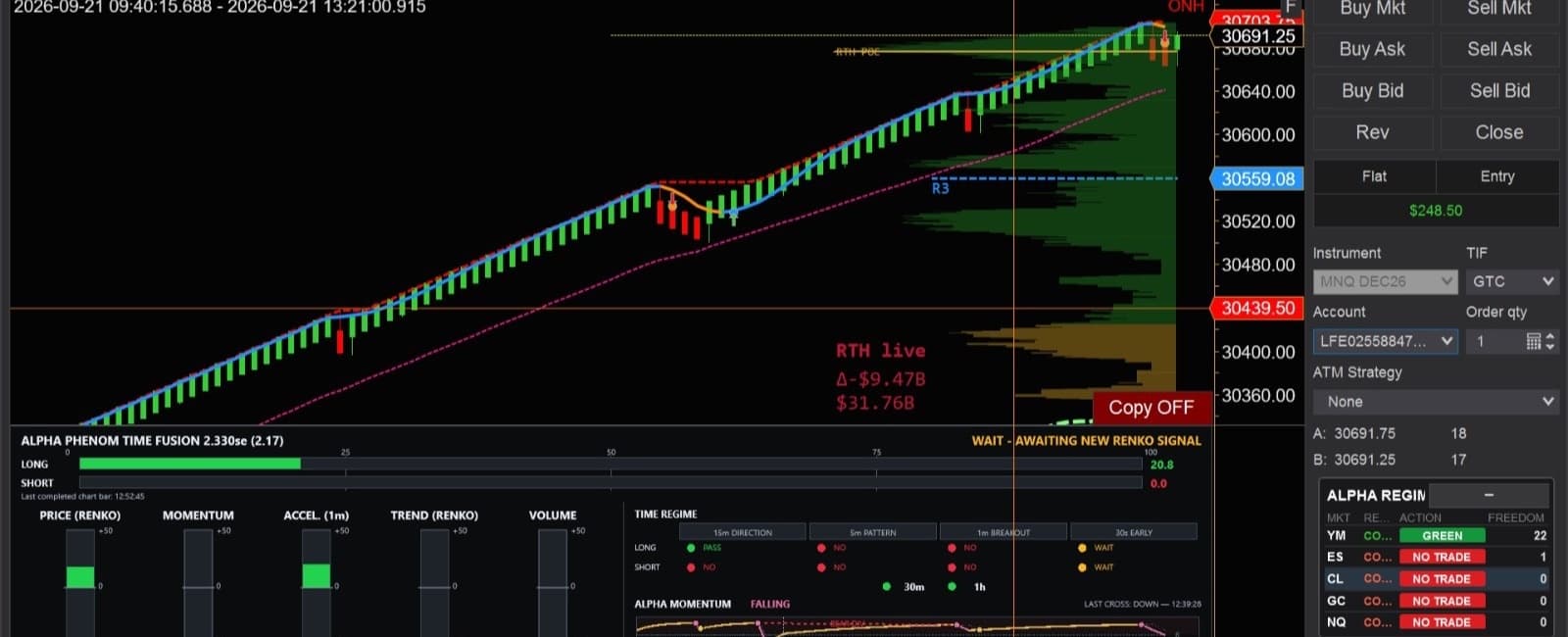
Cross-correlates NQ with ES, YM, GC, and CL. When tech leads but defensives lag (NQ Green, YM Red), the regime is divergent — a warning sign for breakout traps.
Alpha Explosion
Optimized for NQ's 9:30 AM cash open. Detects the first 15-minute volatility compression breakout with volume confirmation — NQ's highest probability intraday setup.
Prop Firm Considerations for NQ
NQ is the most popular instrument for prop firm challenges due to its volatility and directional clarity.
On a $50K Topstep Combine with $2,000 trailing drawdown, a single NQ contract risks $100 per 5-point stop (20 ticks). Use MNQ for tighter risk control.
Apex's EOD trailing drawdown means NQ's intraday volatility peaks don't raise your drawdown floor — trade the cash open aggressively.
Most prop firms allow both NQ and MNQ. Start with MNQ to build cushion, then scale to NQ when your buffer exceeds 2x your average stop-loss.
Alpha Regime's multi-market classification is essential for NQ — tech-heavy corrections can be sudden and severe during mixed regimes.
Frequently Asked Questions — NQ
What is the best time to trade NQ futures?
Should I trade NQ or MNQ for prop firm challenges?
How many ticks is a point in NQ?
What indicators work best for NQ futures?
Is NQ more volatile than ES?
Explore Other Contracts
Trade NQ with Institutional Indicators
Join the Toronto-based live trading desk at 9:20 AM EST. Watch AQS indicators analyse NQ in real-time before you commit. CAD $250/month — all 4 indicators included.